

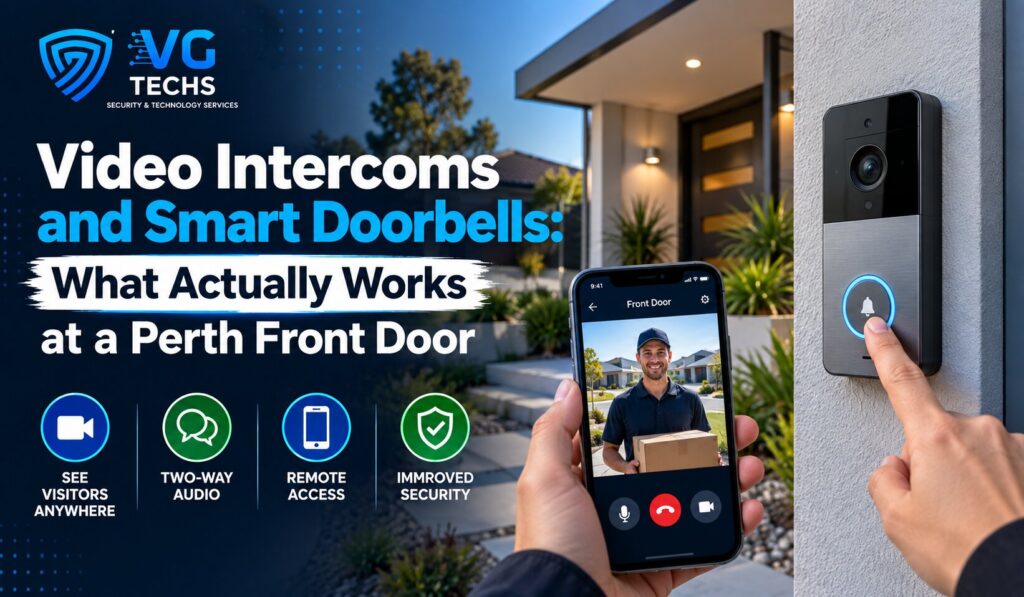
These two products sit side by side in the same aisle and get talked about as if they are the same thing. They are not, and the difference shows up about three weeks after installation, usually at the moment somebody is standing at your gate, and you cannot let them in.
They solve different problems
A smart doorbell is a camera with a button. It sends a notification to your phone, records to a cloud service, and lets you speak to whoever is there through the app. Its whole world is the phone in your pocket.
A video intercom is a door station wired back to a monitor inside the house. It rings in the building like a doorbell always did; it works on your own network rather than someone else’s servers, and because it is wired to something, it can be wired to something useful. A gate motor. An electric strike on the front door. A second monitor in the main bedroom.
Neither is better in the abstract. They suit different doors and different households.
The wiring assumption that does not hold here
Most consumer video doorbells were designed around a house that already has a low-voltage doorbell transformer and a chime wired into it. That is standard in North America. It is not standard in Australia, and manufacturers say so quietly in their own documentation. Ring’s Australian support material notes that local homes are unlikely to have an existing system of that kind, and that any hardwiring here must be carried out by a licensed electrician.
So the simple swap that the packaging implies often turns into one of three jobs. Run it on battery and accept recharging it. Bring in an electrician to fit a transformer. Or accept a visible plug-in lead running from the door to the nearest power point, which tends to look exactly as temporary as it sounds.
Battery, WiFi and double brick
The front door is frequently the furthest point in the house from the router, with the most brick in between. Double brick is unforgiving of wireless signal, and a doorbell sitting at the edge of coverage behaves in a specific way: it connects fine during setup while someone stands next to it with a phone, then drops out intermittently once everyone goes inside.
Battery models add a second issue. To preserve charge, they sleep between events, and waking up takes a moment. That moment is why people report pressing the button and hearing nothing for several seconds, or getting a notification of a visitor who has already left.
The delay nobody mentions until they live with it
A cloud doorbell has a round trip to complete before you can speak. The button is pressed, the event travels to a server, a notification arrives, you unlock your phone, open the app, and wait for the live stream to connect. On a good connection, that is quick. On an ordinary one, the courier has already written the card and walked back to the van.
A wired intercom rings a monitor on the wall immediately, because nothing has left the building. If the point of the exercise is actually talking to people at the door rather than reviewing them afterwards, that difference matters more than any specification on the box.
If you want the gate to open, you need an intercom
This is the part that catches people out on larger blocks and properties with a front gate. Doorbells notify and record. They do not release anything. Opening a gate, a door strike or a boom from the same device you are speaking through is access control, and it needs a door station wired to the hardware doing the opening. Retrofitting that later usually means replacing the doorbell entirely, because the doorbell was never able to do it.
Audio at the front door is not a neutral setting
Both products usually arrive with the microphone on. A device at the front boundary of a narrow block picks up conversations on the footpath as readily as it picks up the person pressing the button, and recording sound is treated very differently in WA to recording pictures. We set out where that line sits in our guide to what you can and cannot legally record, and it is worth a minute before the device goes live rather than afterwards.
Motion alerts deserve the same thought. On a compact lot, the front door sits close to the footpath, so an out-of-the-box motion setting will alert on every passerby, every dog walker and every car. People respond by muting notifications, which defeats the entire purpose. Detection zones exist for exactly this reason and take a few minutes to set properly.
One cable settles most of this
The tidiest version of either product is a single cable to the door carrying power and data together. No battery to recharge, no transformer, no reliance on wireless through brick, and the option of a wired intercom rather than only a doorbell. If you are building, this is one of the pathways worth roughing in at frame stage even if you have not chosen a device yet. If the house already exists, the run is still very achievable; it just takes a little more planning.
Frequently asked questions
Can it ring inside the house as well as on my phone?
With an intercom, yes, because the indoor monitor is the product. With a smart doorbell, it depends on the model. Some include a separate plug-in chime, some work with a compatible speaker you already own, and some rely entirely on phone notifications. If somebody at home does not carry a phone everywhere, check this before buying rather than after.
Why does my doorbell keep dropping off the WiFi?
Usually distance and building material rather than a faulty device. The front door is often the weakest coverage point in a brick home, and a doorbell will report a connection during setup that is not stable enough for video afterwards. A wireless access point positioned toward the front of the house fixes it in most cases. A wired device removes the problem altogether.
Does an intercom still work if the internet goes down?
A wired intercom will still ring the indoor monitor, let you see and speak to the visitor, and release a gate or strike, because all of that happens inside your own network. What stops is remote access from outside the house. A cloud doorbell generally stops doing anything useful at all, which is worth knowing if your connection is unreliable.
Can I fit one in a rental?
A battery doorbell mounted with adhesive or existing screw holes is usually straightforward with the owner’s agreement. Anything involving drilling into brick, running cable or connecting to a gate needs written permission first, and the same applies to strata properties where the front entry may be common property rather than yours.
The door decides the product, not the review you read
Whether a doorbell or an intercom is right depends on what is physically at your entry: how far it is from the router, whether there is a gate, whether power or cable can reach it, and who in the house needs to answer it. That is a five-minute conversation, and it saves buying the wrong thing twice. VG Techs holds Security Licence No. 71264, WA Security Provider 7126 and Master Cabler A045514, and we install both types rather than selling one.
Send us a photo of your front entry, and we will tell you honestly which way to go. Call 0472 652 026, email admin@vgtechs.com.au, or book an installation. Based in Piara Waters, servicing greater Perth from Rockingham to Joondalup, Monday to Friday, 8 am to 6 pm.