

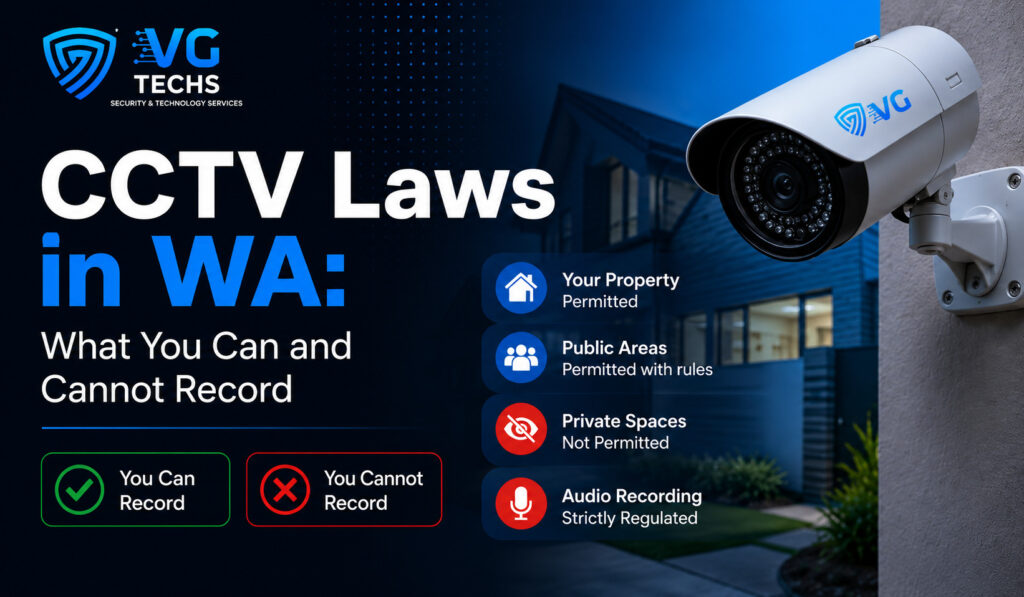
Most people in Perth put cameras up to protect a house, a workshop or a business, not to watch anybody. The difficulty is that the line between security and surveillance is drawn by legislation rather than by common sense, and Western Australia draws it differently from the eastern states. A setup that would be completely unremarkable in Sydney can create a real headache here, usually because of one feature that most owners never think to check.
The law that actually applies to your cameras
Camera use in this state is governed by the Surveillance Devices Act 1998 (WA), which deals with listening devices, optical surveillance devices and tracking devices. A security camera sits in the second group. Section 6 makes it an offence to install, use or maintain an optical surveillance device to visually record or observe a private activity that you are not a party to.
Two things follow from that wording. The first is that this is criminal legislation, so a complaint is not simply a neighbourly disagreement. The second is that the test turns on the phrase private activity, not on where the camera happens to be bolted. You can own the wall, the bracket and every metre of cable and still have a problem with what the lens is pointed at.
The Act does allow for exceptions, including recording that occurs unintentionally and use that is reasonably necessary to protect a person’s lawful interests. Those exceptions are narrower than most people assume, and none of them is a substitute for aiming the camera properly in the first place.
Where the line sits at your boundary
Covering your own driveway, front door, side gate, yard and shed is not the issue. Neither is a camera that takes in the verge, the footpath or the road, since coverage of genuinely public space is generally accepted and the Act recognises circumstances where use serves the public interest.
Trouble starts when a lens reaches into areas where somebody else reasonably expects privacy. A neighbour’s back lawn, their pool, a bedroom or bathroom window, or a courtyard behind a dividing fence all fall into that category. On the narrow blocks now common through the newer estates we work across, a wide-angle camera under a second-storey eave can see well past the boundary without the owner ever realising. That is a placement problem, and it belongs at the design stage of a security camera installation rather than in a conversation with the person next door six months later.
Audio is the part that catches people out
Section 5 of the same Act covers listening devices, and it is stricter than the camera provisions. Recording a private conversation is an offence, and that holds whether or not you are one of the people talking, subject to limited exceptions.
This matters because a large share of current cameras and video doorbells ship with the microphone switched on out of the box. A unit at the front door that captures what two people are saying on the footpath is doing something the law treats very differently from filming them. Unless there is a specific reason to record sound, the safest configuration is to disable audio at the camera or in the recorder, and the product guides on our site show where that setting lives on the systems we commonly install.
What changes when the cameras are at a business
Western Australia has no dedicated workplace surveillance act. New South Wales and the ACT both require written notice to employees before camera surveillance begins, and because there is no direct equivalent here, some operators assume anything goes. It does not. The Surveillance Devices Act applies to a workplace exactly as it applies to a home, and the federal Privacy Act 1988 applies on top of it to organisations above the three million dollar annual turnover threshold, plus some smaller ones.
In practice, a defensible commercial setup means signage at entry points, telling staff that cameras exist and why, keeping cameras out of bathrooms and change rooms entirely, leaving audio off, and recording in writing who may view or export footage. We work through these questions at the design stage on warehouse, office and retail sites, and the projects we have completed give a sense of how differently a compliant layout looks across a logistics yard compared with a shopfront.
Setting up so the question never comes up
- Aim at your own entry points. A camera looking along your driveway, gate, garage or roller door collects better evidence than one sweeping a wide arc across two properties.
- Use privacy masking. Most current recorders let you permanently black out fixed regions of the frame, so a neighbouring window is never captured even where the camera legitimately covers your side of the fence.
- Match the lens to the job. A narrower field of view at the correct mounting height will usually give you a recognisable face at the gate, whereas a wide-angle unit mounted high gives you a lot of roof tiles and a lot of somebody else’s yard.
- Put up a sign. It is not legally required at a private home, but it removes ambiguity and adds deterrence at no cost.
- Think before you share. The Act also restricts publishing or communicating information obtained about private activities, so posting neighbour footage to a community Facebook page is a separate question from whether you were allowed to record it.
The short version
None of this is legal advice, and anyone in a live dispute with a neighbour or an employee should speak to a lawyer. For the ordinary job, though, compliance is decided by camera placement, lens selection and a handful of recorder settings, all of which are locked in on installation day. Getting them right at the start costs nothing extra. Repositioning a finished system across a property in any of the suburbs we cover costs a great deal more.
Frequently asked questions
Can I point a camera at the street outside my house?
Generally yes. A road, footpath or verge is public space, and incidental coverage of it while you are protecting your own frontage is widely accepted. The caution is that a camera angled to take in the street will often catch a neighbour’s front yard or window on the way, so check the live view rather than assuming.
My neighbour has installed a camera facing my property. Is that allowed?
It depends entirely on what the camera can see, not on where it is mounted. If it captures your driveway or the front of your house in passing while covering their own boundary, that is usually fine. If it looks into your yard, windows or pool area, it may fall foul of section 6. Speaking to them directly resolves most of these, since the fix is often a five-minute angle adjustment or a privacy mask.
Is it illegal to record audio with my security cameras in WA?
Recording private conversations is treated far more strictly than recording video, and the exceptions are limited. Most homes and small businesses have no operational need for sound, so turning the microphone off removes the risk entirely.
Do I need to display CCTV signage at my home?
There is no requirement for signage at a private residence in WA. At a workplace, it is a different matter, because notifying staff and visitors is part of demonstrating that surveillance is being conducted openly and for a legitimate purpose.
Planning a system that stays on the right side of the line
Camera angles, lens choice, masking zones and audio settings are all decided during the site walk, not afterwards. VG Techs holds Security Licence No. 71264, WA Security Provider 7126 and Master Cabler A045514, and we walk every property before quoting so the coverage plan is agreed before a single bracket goes up.
Call 0472 652 026, email admin@vgtechs.com.au, or book a site assessment through the website. We are based in Piara Waters and service the greater Perth area from Rockingham to Joondalup, Monday to Friday, 8 am to 6 pm.