

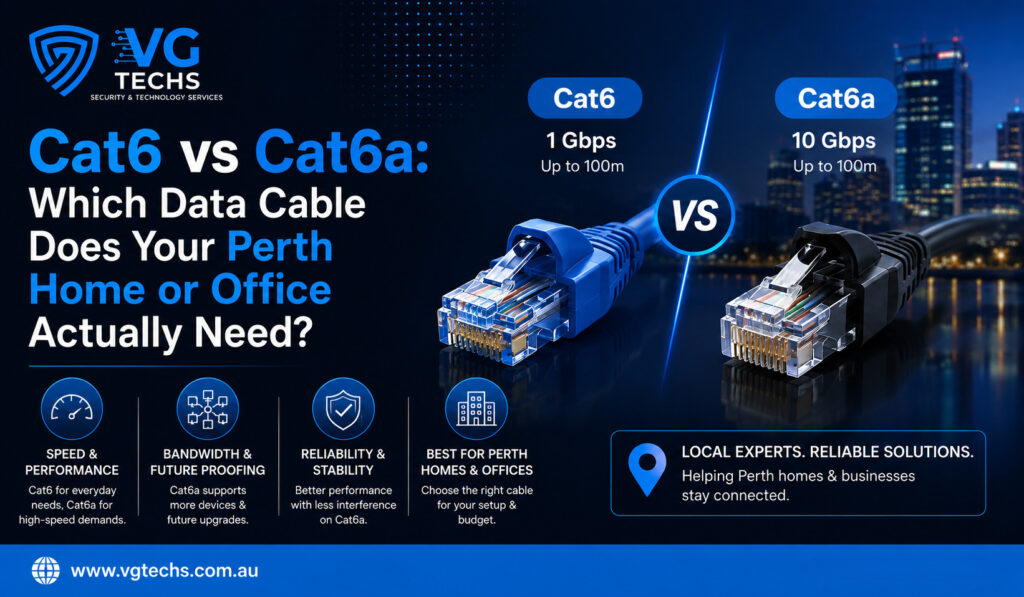
Ask three installers whether you need Cat6 or Cat6a, and you will get three answers, usually delivered as a specification table that nobody outside the trade can read. The decision is simpler than it looks. It comes down to how long your longest cable run is, what you expect to plug in over the next decade, and how hot the space above your ceiling gets in February. The third one almost never makes it into the conversation, and in Perth it should.
What actually separates the two
Both are four-pair twisted copper, both terminate on the same RJ45 connector, and both carry gigabit comfortably across a full hundred metre run. The difference only appears when you ask for ten gigabit.
Cat6 is characterised to 250 MHz. Ten-gigabit Ethernet needs a clean signal well above that figure, so the standards limit Cat6 to roughly 55 metres at that speed. Cat6a is characterised to 500 MHz and is additionally tested for alien crosstalk, which is the interference cables induce in their neighbours when they sit bundled together in a tray or conduit. That testing is the reason Cat6a holds ten gigabit across the full hundred metres.
Physically, Cat6a is thicker, stiffer and heavier. It needs a larger bend radius, it fills conduit faster, and it takes longer to terminate neatly. On a retrofit through existing walls, those are real constraints, not just line items on a quote.
The 55 metre figure is a ceiling, not a promise
That number comes from the standards as a guideline, and it assumes favourable conditions: cables run loosely, not crowded into a bundle, at a sensible temperature. Pull six Cat6 runs tight through a single pathway and the usable ten gigabit distance drops, in poor conditions, to well under forty metres.
Perth adds a variable that most cable comparison articles ignore entirely. Insertion loss in copper climbs as temperature rises, and a roof cavity in a single-storey home here can sit far above the twenty degrees the standards assume for a good part of the year. A link that certifies with a comfortable margin in July can sit much closer to the edge in January. On a run already near the limit, that is the difference between a network that works and one that drops out on hot afternoons and mysteriously behaves itself again by evening.
It is also the reason we measure the longest intended run before recommending a category, rather than picking a category and hoping the run fits.
Power over Ethernet changes the arithmetic
Most people think about data cabling as data first. In practice, on the sites we wire, the same cable is usually powering something as well: ceiling access points, door stations, access control readers and security cameras. Power moving through copper generates heat, heat raises insertion loss, and heat trapped in the middle of a tight bundle has nowhere to go.
Cat6a’s larger conductors cope with that better. Where a plan involves a row of powered devices fed along one common pathway, the thermal argument for Cat6a often carries more weight than the ten gigabit argument that gets all the attention.
When Cat6 is still the sensible choice
Cat6 is not obsolete and specifying Cat6a everywhere is not automatically the professional answer. In a typical Perth home, the longest run from the comms cupboard to the far bedroom rarely passes forty metres. That gives you gigabit to every outlet with headroom for ten gigabit on the shorter runs, at a lower cost per metre, with easier pulls through existing cavities and faster terminations.
Cat6a earns its place in four situations: runs that approach or exceed 55 metres, dense bundles sharing a single pathway, industrial and warehouse spaces with motors and other electrical noise nearby, and any building where the ceiling is not going to be reopened for a decade.
That last one usually decides it. The cable itself is rarely the biggest line on the invoice. The labour to pull it is. Paying to pull cable twice is the genuinely expensive outcome, which is the same logic behind smart wiring a house at frame stage instead of retrofitting once the plaster is up.
The part of the job that has nothing to do with the category
Fixed communications cabling in Australia is not DIY territory. Under the ACMA cabling provider rules, cabling work across the telecommunications, security, fire and data industries must be carried out by a registered cabler or by someone working under the direct supervision of one, and it must comply with the AS/CA S009 wiring rules. Those rules cover practical things, including keeping communications cabling properly separated from electrical cabling.
There is one more requirement worth knowing as a customer. On completion, the cabler must prepare a written statement certifying the work complies with the wiring rules, and must give you a copy. Most homeowners have never been offered one. If a quote for data and network cabling says nothing about registration or a compliance certificate, that is a fair question to ask before you accept it.
The short version
Measure the longest run first, then choose. Under about forty metres with modest power demand, Cat6 is a sound, cost-effective decision. Approaching 55 metres, bundled through a hot roof space, feeding powered devices, or disappearing into a ceiling that will stay shut for the next ten years, specify Cat6a and stop thinking about it.
Frequently asked questions
Can I mix Cat6 and Cat6a in the same building?
Yes, and it is often the sensible approach. A common pattern is Cat6a on the long backbone runs and anywhere powered devices are clustered, with Cat6 on the short horizontal runs to desks and bedrooms. Each link performs to its own weakest component, so mixing does not degrade the runs that were done in the higher specification.
Will upgrading to Cat6a make my internet faster?
Almost certainly not. Your internet speed is set by the service coming into the building, not by the cable inside it. What better cabling improves is everything moving between devices on your own network: file transfers to a local server, camera footage written to a recorder, backups, and wireless performance where the access points are fed by good cable.
Do I need to rip out existing Cat5e?
Not necessarily. Cat5e still carries gigabit across a full-length run and remains perfectly serviceable for ordinary desktop and wireless use. The case for replacing it arises when you are adding powered devices, chasing ten gigabit between key points, or when the existing cable is unlabelled, untested or was clearly run without regard for separation from power.
How long should new data cabling last?
Well-installed structured cabling is generally treated as a fifteen- to twenty-year asset, which is considerably longer than the switches, recorders and access points plugged into it. That mismatch is exactly why the category decision deserves a few minutes of thought. You are choosing for the equipment you have not bought yet.
Get the run lengths measured before anyone quotes you a category
The right answer here is site-specific, and it cannot be worked out over the phone. VG Techs is a registered cabler, Master Cabler A045514, and we hold Security Licence No. 71264 and WA Security Provider 7126 for the camera and access control work that usually shares the same pathways. Every data job we complete comes with the compliance paperwork the wiring rules require, not just a working outlet.
If you are building, extending, fitting out a tenancy or simply tired of a network that struggles in summer, call 0472 652 026, email admin@vgtechs.com.au, or request a quote. Based in Piara Waters, servicing greater Perth from Rockingham to Joondalup, Monday to Friday, 8 am to 6 pm.