

The footage looks fine at 3 pm. Then someone checks the same camera after an incident at 2 am and finds a grey smear with a bright glowing patch where a face should be. This is one of the most common complaints we hear about CCTV in Perth homes and businesses, and it is rarely because the camera is faulty. Night vision depends on a handful of physical limits, and most poor results come from how and where the camera was set up.
How night vision CCTV actually works
Most cameras with night vision use small infrared LEDs ringed around the lens. When the light drops, the camera flips a mechanical filter out of the way, switches to black and white, and relies on those LEDs to light the scene with infrared that you cannot see. The image the recorder keeps is a monochrome picture built from reflected infrared.
That has two consequences. First, the camera can only see what the infrared reaches and bounces back, so range matters. Second, anything very close to the lens reflects far more light than anything far away, which is why a person walking towards the camera can turn into a white blob.
Infrared versus colour night vision
Some newer cameras use sensitive sensors and a small amount of ambient light, such as a streetlight or a porch light, to keep recording in colour. Others add a built-in white light that switches on when movement is detected. Colour helps describe clothing or a vehicle, but in a truly dark side yard these cameras fall back to infrared anyway.
Why your footage goes grainy or washed out
Poor night footage usually comes down to a short list of causes, and several of them can be fixed without replacing the camera.
The camera is too close to a wall or an eave
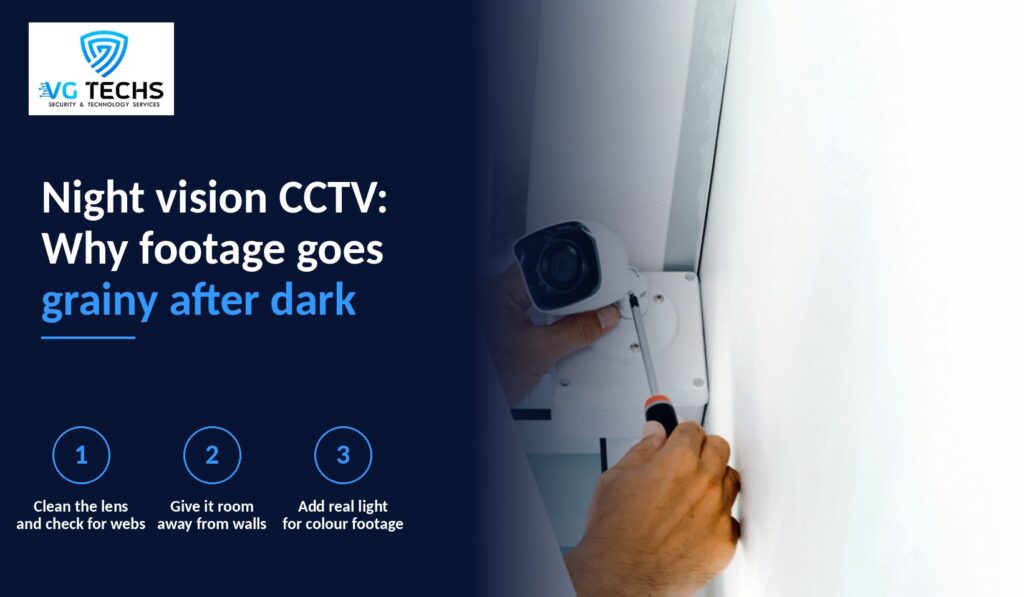
Infrared light bounces off nearby surfaces straight back into the lens. A camera mounted tight under an eave or beside a wall can fill the frame with a washed-out glow, while the area you actually care about stays dark. A few centimetres of extra clearance, or an angle that points away from the wall, can change the picture completely.
Insects, spider webs and dust
Spiders love the warmth of a camera and its infrared LEDs. A single web across the lens lights up like a neon tube at night, and moths and other insects drifting past create streaks and flashes that can trigger false motion alerts. Regular cleaning, and moving the camera away from lights that attract insects, makes a real difference.
Glass in front of the lens
Placing a camera behind a window is tempting, but the glass reflects the infrared right back, leaving a glare ring across the picture. Outdoor mounting gives a much cleaner result.
The scene is simply too big for the camera
Every camera has an infrared range, and the number on the box is measured in ideal conditions. Wide lawns, long driveways and open car parks often sit beyond what a small camera can light well.
Compression and low bitrates
Dark scenes are hard for a recorder to compress, so a system tuned to save disk space may smear detail at night. If your recordings look fine by day and blocky after dark, the recording settings are worth checking alongside the camera itself. Our guide on how much CCTV storage you actually need explains how bitrate and drive size affect what gets kept.
What helps, and what is usually a waste of money
A higher megapixel count does not fix a dark scene. More pixels on a small sensor can even make low light worse, because each pixel catches less light. What matters more is the sensor quality, the lens aperture and the position of the camera.
These changes tend to help most:
- Light the area properly with a motion-activated outdoor light, so the camera has real light to work with and can keep colour.
- Place cameras to cover the approach to an entry point rather than the whole property, and keep the subject within a comfortable distance.
- Choose cameras with a wider infrared spread and good low-light sensors for dark areas, rather than relying on one camera to cover everything.
- Have the recording settings checked so night footage is not being compressed too aggressively.
Placement matters as much as the camera
Where a camera sits decides whether it will see a face or only a silhouette. Our post on the best locations to install security cameras walks through entry points, driveways and side access, and many of those tips matter most after dark.
Testing your cameras at night
The only reliable way to know how your system performs is to look at it in the dark. Pick a night when it is not raining, walk through the frame at the distances you care about, then play the recording back on the same screen you would use after an incident. If the picture is poor, small changes to angle, lighting and settings can often fix it before you consider new hardware.
When a professional look is worth it
If you have already moved a camera and still cannot get a usable night picture, the cause is often the combination of lens, lighting and mounting height. A technician can test the view on site, suggest where extra lighting makes sense, and tell you honestly whether the camera needs replacing. For homes and businesses that want a reliable after-dark picture, a properly designed system from our security camera installation team starts with checking the site at night, not guessing from a floor plan.
Frequently asked questions
Why does my CCTV picture turn black and white at night?
The camera switches to infrared mode when light drops, which removes the colour filter and records only brightness. Colour at night is possible only when there is enough visible light on the scene.
Why is there a bright glow in the centre of my night footage?
Infrared bouncing off a nearby surface, a web or dust on the lens often causes this. Cleaning the lens and adjusting the angle usually helps.
Do more megapixels give a clearer picture in the dark?
Not necessarily. Sensor quality, lens aperture and available light matter more than resolution, and a higher resolution on a small sensor can add noise in low light.
Can I put a camera behind a window?
You can, but the glass reflects infrared back into the lens and creates glare at night. Outdoor mounting, or a camera designed for the purpose, gives a cleaner result.
Will a floodlight help my cameras?
Often yes. A motion-activated light gives the camera real light to work with, which can improve detail and allow colour footage, as long as the light is not shining straight into the lens.
Get night footage you can actually use
If your cameras look fine by day and fall apart after dark, we would be glad to take a look at the problem and suggest practical fixes without pressure. Our licensed team can check your camera positions, lighting and settings on site, then explain what is worth changing.
Call 0472 652 026, email admin@vgtechs.com.au, or book a site visit. Based in Piara Waters, servicing greater Perth from Rockingham to Joondalup, Monday to Friday, 8 am to 6 pm.